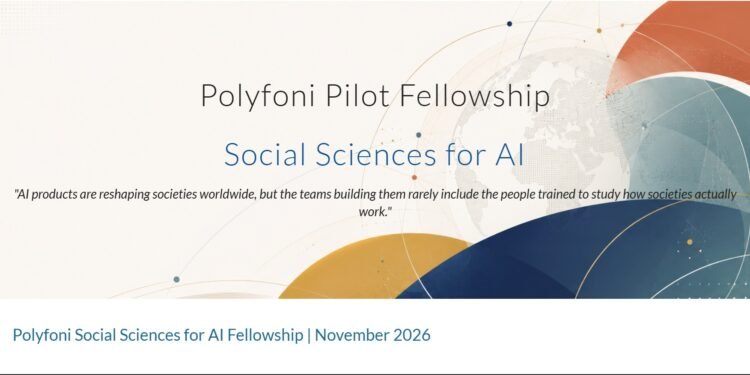
This call closed on 15 October 2026. Polyfoni, an Oslo-based organization that brings social science expertise into AI development, recruited for its Social Sciences for AI Fellowship 2026-2027. Over four months, part-time and remote, fellows were to run a cultural audit of an AI product deployed in a region they know, with academic and industry mentors. Applications closed on October 15, 2026, and were reviewed on a rolling basis.
At a glance
| Deadline | Closed on 15 October 2026 |
| Who can apply | MSc and PhD students and early-career researchers in the social sciences and humanities |
| Duration | November 2026 to March 2027, about 5 hours per week |
| Format | Remote |
| What you get | Dual mentorship, training in the Cultural Audit Method, and a published research report under your name |
| Official link | Polyfoni fellowship page |
What is a cultural audit of an AI product?
Polyfoni defines it as a structured empirical analysis of how a specific AI product encodes assumptions about the context where it is deployed, and where those assumptions break. The work covers assumption mapping, identifying contextual failures, assessing their severity and writing recommendations.
Who could apply?
According to the official fellowship page, Polyfoni was looking for:
- MSc and PhD students and early-career researchers.
- Backgrounds in anthropology, sociology, STS, development studies, political science, the humanities or area studies.
- Fieldwork experience in Global South contexts and demonstrated regional expertise.
- English proficiency.
Note for readers in the Arab world: priority regions for this round were East Africa, South Asia, Southeast Asia, Latin America and China. The Middle East and North Africa was not on that list, although the page did not explicitly exclude other regions and encouraged people to apply even if they did not meet every qualification.
What did fellows get?
- Dual mentorship from an academic and an industry professional.
- Training in Polyfoni’s Cultural Audit Method.
- Online masterclasses and monthly group sessions.
- A published research report under the fellow’s name.
- Career guidance and networking.
The official page did not mention a stipend or other compensation.
How did applications work?
- Applicants wrote a motivation statement of up to 500 words in English.
- It was submitted through the official application form before October 15, 2026. Review was rolling, so early applications were considered first.
- Shortlisted candidates moved to a CV review and an interview with the Polyfoni team.
If the fellowship reopens, check the official fellowship page. Questions: contact@polyfoni.no.
Key dates
- Applications closed: October 15, 2026
- Fellowship starts: November 2026
- Fellowship ends: March 2027
FAQ
The page did not require one. The fellowship targeted social scientists and included methods training.
Polyfoni did not mention a stipend.
Yes. It was remote and took about 5 hours per week.
Source: Polyfoni, Social Sciences for AI Fellowship.
More opportunities on al-khwarizmi: Perplexity Research Fellowship 2027 and OpenAI AI and Teen Development Research Grant Program.