
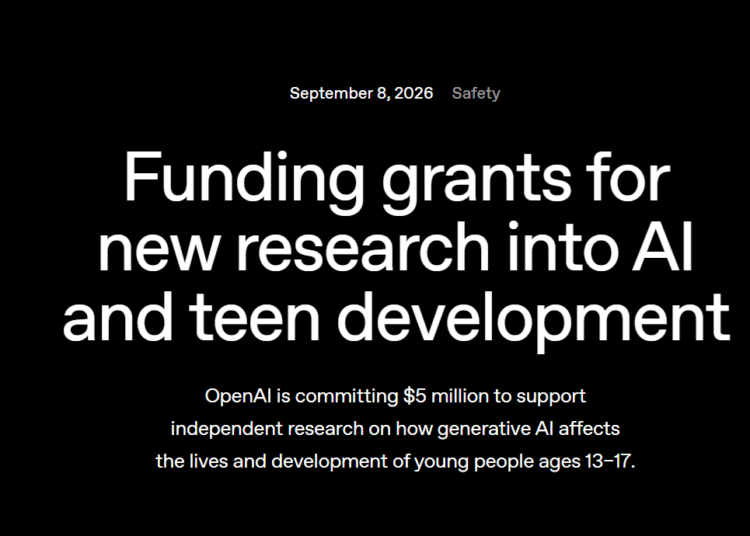
OpenAI has opened a new grant program aimed at independent research on how generative AI affects teenagers’ lives and development. The company is committing up to $5 million in total funding, with individual research grants of up to $1 million, for projects focused on young people ages 13–17. Applications opened September 8, 2026, and remain open until October 6, 2026, at 11:59 p.m. Pacific time.
The program arrives as schools, families, policymakers, and technology companies continue to evaluate how teens use AI for learning, creativity, advice, emotional support, and social interaction. For researchers tracking youth grant opportunities, OpenAI’s AI and Teen Development Research Grant Program is notable because it centers evidence-building rather than product promotion, with particular attention to adolescent social and emotional development.
What is OpenAI funding through this grant program?
OpenAI is funding independent research that can clarify how teens use generative AI, what benefits or risks may emerge, and which safeguards or design choices could make AI tools more age-appropriate. The company says it wants evidence that can inform product development for teens and contribute to public debates among policymakers and regulators. Eligible approaches may include qualitative, quantitative, experimental, observational, theoretical, participatory, or mixed-methods research.
The research priorities include emotional development and well-being, social development and relationships, usage patterns across different contexts and demographics, and interventions such as AI literacy, parental or educator support, safeguards, and healthy-use practices. OpenAI says it welcomes interdisciplinary proposals from areas including child and adolescent development, psychology, public health, human-computer interaction, communication, sociology, anthropology, data science, and AI safety.
Key dates and funding details
Researchers considering this OpenAI grant should move quickly because the application window is short. OpenAI says applications are reviewed on a rolling basis by internal experts and advisors, with selected proposals expected to be notified on or before November 13, 2026. The application portal lists the program as opening September 8, 2026, at 8:00 a.m. PDT and closing October 6, 2026, at 11:59 p.m. PDT.
Key program details include:
- Total available funding: Up to $5 million across the program.
- Maximum individual grant: Up to $1 million per research project.
- Indirect costs: No more than 10% of a project’s grant may support overhead or indirect costs.
- Applicant age: Applicants must be 18 or older.
- Applicant background: Applicants must be affiliated with a research institution or organization and/or have significant relevant experience in areas such as child or adolescent development, well-being, human-computer interaction, AI impacts, or a related field.
- Project timeline: OpenAI states a strong preference for projects that can produce final results quickly and asks for a working draft within 12 months of receiving funds.
Applications can be submitted through the program page.
Research involving minors will face heightened safeguards
Because the program focuses on teenagers, OpenAI’s guidance places significant emphasis on research ethics. Applicants proposing studies involving minors must explain their ethics-review process, consent and age-appropriate assent procedures, privacy and data protections, and plans for responding to disclosures of harm or imminent risk. Projects involving sensitive personal, behavioral, or mental-health information are not automatically ineligible, but OpenAI says they may require additional review, expertise, safeguards, and time.
That emphasis matters for any team treating this as a youth innovation grant opportunity. A strong proposal is unlikely to rely only on an interesting research question; it must also show that the team can protect teen participants and responsibly handle sensitive data. For studies in schools, clinics, community organizations, or online youth environments, applicants should be prepared to describe recruitment plans, feasibility, safeguarding expertise, and compliance with relevant rules for research involving minors.
What applicants need to submit
OpenAI says applications must be submitted in English, although the research itself may be conducted in any language. The company asks applicants to format their materials as a single-spaced Google document and include a project summary, research proposal, project plan and timeline, budget, project dependencies, ethics and safeguarding statement where relevant, team information, and disclosures related to independence and conflicts of interest.
The research proposal is limited to no more than three pages excluding references and should cover the research questions, prior research, proposed methods and analysis, study population, recruitment strategy, expected outputs, limitations, and relevance to the program’s goals. OpenAI also asks for a budget justification that identifies major cost categories and any other committed sources of support.
How proposals will be reviewed
OpenAI says proposals will be evaluated for scientific rigor, relevance, proposal quality, actionability, ethics and safeguarding, feasibility, team expertise, inclusion and generalizability, complementarity with OpenAI’s internal research agenda, and independence and credibility. Preference may be given to research involving ChatGPT, interdisciplinary teams, underrepresented populations or regions, and work that can inform near- or medium-term policy and regulatory decisions.
Expected outputs include a final report describing the research question, methods, results, evidence, limitations, uncertainty, and recommendations where supported by findings. OpenAI also says it requires an interim progress update in Q1 2027 and encourages researchers to make findings publicly available through a peer-reviewed publication, preprint, public report, or similar format, though publication is not listed as a condition of funding.
Why the announcement matters
The new openai funding program comes at a time when generative AI is becoming more common in teen learning, communication, and information-seeking. OpenAI’s framing suggests the company is looking for evidence that reflects complexity: AI’s effects may vary depending on a teen’s age, culture, language, socioeconomic context, purpose of use, and support from adults and institutions.
For universities, nonprofits, research institutes, and experienced independent teams, the program adds a significant openai grant option to the landscape of youth grant opportunities. It may be especially relevant for teams that can produce actionable, ethically sound research on teen well-being, relationships, safety interventions, or policy-relevant design practices before the deadline closes on October 6, 2026.