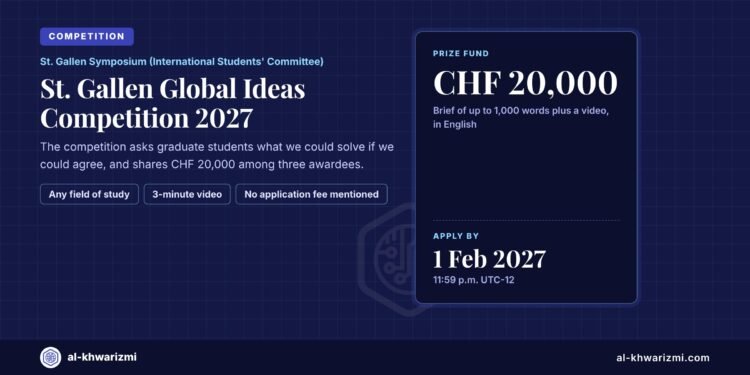
The St. Gallen Global Ideas Competition 2027 asks graduate students: what could we solve, if we could agree? If you study AI, data, cybersecurity or automation, your field may hold a stuck problem that needs a new arrangement between the parties involved. The St. Gallen Symposium shares CHF 20,000 among three awardees. The deadline is 1 February 2027.
At a glance
| Deadline | 1 February 2027, 11:59 p.m. (UTC-12, the last time zone) |
| Who can apply | Master’s level students or higher at a regular university, born in 1997 or later, any nationality, individual entries only |
| Prize fund | CHF 20,000 shared by three awardees |
| Top 100 | Expenses-paid place at the 56th St. Gallen Symposium (travel, board and lodging covered, per the organizer) |
| What to submit | Solution Brief of up to 1,000 words and a Video Explainer of up to 3 minutes, in English |
| Cost to apply | The page mentions no application fee |
| Official link | St. Gallen Global Ideas Competition |
Who can apply
- You are enrolled in a master’s level programme or higher on 1 February 2027, in any field of study.
- You were born in 1997 or later. The competition does not restrict nationality.
- Your institution is a regular university: it conducts research and offers at least one PhD programme. The organizer decides exceptions case by case.
- You apply as an individual. Teams cannot enter, and bachelor’s students are generally ineligible.
What you get
Three awardees share CHF 20,000, and the strongest competitors present on the Symposium’s main stage. The top 100 selected candidates qualify as Leaders of Tomorrow with an expenses-paid place at the Symposium in St. Gallen. The organizer states that participation is free and that travel, board and lodging are covered.
How to apply
- Identify a solvable problem that stays stuck because the parties cannot agree, and propose a novel arrangement that would solve it more effectively.
- Write the Solution Brief in English on the official template: up to 1,000 words, four sections. References and the optional evidence annex do not count toward the limit. It must be anonymous and written only for this contest.
- Record a Video Explainer of up to 3 minutes with no slides (MP4 or MOV at 720p or higher, or a YouTube or Vimeo link).
- Register on the official application portal with a 200 to 300 word abstract, a passport or other official ID, and a confirmation of matriculation.
Results are announced by e-mail by mid-March 2027. The 56th Symposium takes place in St. Gallen, Switzerland, in April 2027. The organizer’s page gives 27 to 29 April in one place and 28 to 29 April in another, so check the exact days with the organizer before booking anything.
How to prepare a stronger entry
- Start from a field you know. The first round scores originality, the strength of the argument and the evidence, so pick a problem you can support with sources from your own area of study.
- Keep a record of AI use. The rules require you to declare AI use and cite every source. Note which tools you used and for what from day one.
- Respect the word limit. The limit is 1,000 words for the main text, so cut background and move supporting detail into the references or the optional annex.
- Keep the video plain. Slides are not allowed. A clear spoken explanation shows the idea is yours, which is what the second round checks.
Frequently asked questions
The official page does not limit the problem to one domain. It requires that you are enrolled in a graduate programme in any field.
English.
By e-mail by mid-March 2027.
The organizer treats exceptions case by case. Use the contact page on the official site to ask before you apply.