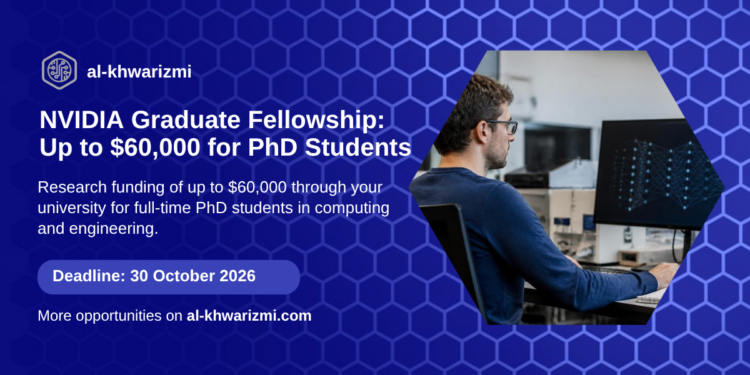
This call closed on 30 October 2026. NVIDIA ran applications for its 2027-2028 Graduate Fellowship, which offered up to $60,000 in research funding per award, administered through the winner’s university, to PhD students in computer science, engineering and related fields. The deadline was 30 October 2026, and it included recommendation letters. This guide records what the call required.
At a glance
| Deadline | Closed on 30 October 2026, including recommendation letters |
| Who could apply | Full-time PhD students in computer science, computer engineering, system architecture, electrical engineering or a related field who had completed the first year of the PhD |
| Benefit | Up to $60,000 per award, administered through the university |
| Format | Required in-person summer internship at one of nine locations listed on the page |
| Cost to apply | No fee mentioned on the official page |
| Official link | Graduate Fellowship page |
Who could apply?
The official page set these conditions:
- Applicants had completed their first year of PhD-level studies before applying.
- Their field was computer science, computer engineering, system architecture, electrical engineering or a close relative.
- They were actively engaged in thesis research and were to stay full-time students through the award year.
- They were to complete a summer internship at NVIDIA, which was required.
- They could not be full-time NVIDIA employees or immediate family members of one.
The page stated that international students could apply and that past fellows could reapply each year.
What did the fellowship offer?
For the 2027-2028 fellowship, the page described funding of up to $60,000 per award, paid through the university to cover stipend, tuition and mandatory fees. It described the award as a gift with no overhead or indirect costs. Winners were to be notified on 15 January 2027.
Research areas listed included generative AI, language models and neural architectures, autonomous vehicles, computational imaging, computer architecture, graphics, healthcare, networking, parallel programming, robotics, security and quantum computing.
How applications worked
- Applicants were asked to open the official fellowship page and check that their status matched the conditions.
- The application required a research proposal of up to two pages, plus a bibliography.
- It also required a resume or CV with contact details.
- Two to three recommendation letters were required, at least one from the thesis advisor.
- Applicants confirmed their availability for the summer internship, then submitted through the application portal linked from the official page before 30 October 2026.
Key dates: applications opened on 30 September 2026, the deadline was 30 October 2026 (including recommendation letters), and winners are to be notified on 15 January 2027. If the call reopens, check the official page.
Advice from the al-khwarizmi team
- For a future cycle, if one is announced, researchers in AI or data science would do well to tie the proposal to one of the research areas the page lists. Relevance to NVIDIA’s research domains was one of the stated evaluation criteria.
- The committee looked at student quality (recommendations, grades, achievements) and research quality (results, proposal, publications). The strongest results and publications belonged up front.
- The page noted that at least one publication was typically needed to be competitive.
- Recommenders needed to be asked early, since the deadline covered their letters as well as the applicant’s own materials.
FAQ
Yes. The official page said international students were eligible.
Yes. The page required an in-person summer internship in the United States, Canada, Germany, Sweden, Finland, Switzerland, Israel, Taiwan or Singapore.
No. Applicants had to complete the first year before applying.
The page said past fellows could reapply each year.
Source: NVIDIA, Graduate Fellowship.