
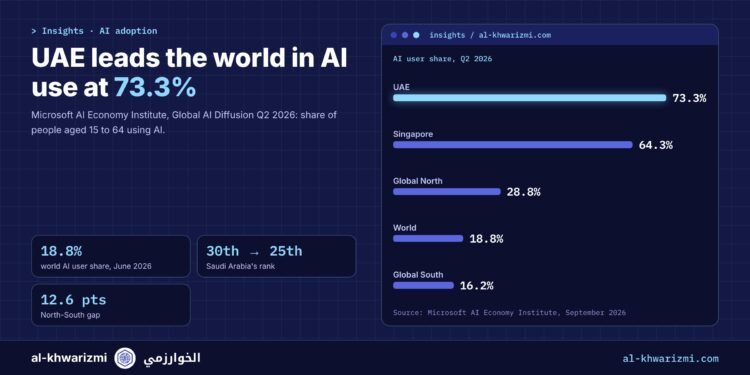
73.3% of the working-age population in the UAE used generative AI tools in the second quarter of 2026, the highest rate in the world, against a global average of 18.8%, according to Global AI Diffusion, Q2 2026, published by the Microsoft AI Economy Institute on 21 September 2026.
About the report
| Publisher | Microsoft AI Economy Institute |
| Released | 21 September 2026 |
| Title | Global AI Diffusion, Q2 2026: Trends and Insights |
| Data covered | Share of people aged 15 to 64 who used a generative AI product during the quarter, based on aggregated, anonymized Microsoft telemetry, adjusted for operating system share, Internet penetration and population |
| Latest edition? | Yes, quarterly, latest as of November 2026 |
A note on method: the report comes from a technology company and relies on usage data from its own products. Read its figures as an estimate of AI diffusion, not as official statistics.
Key findings
- AI users made up 18.8% of the world’s working-age population in June 2026, up about one percentage point from the first quarter, according to Microsoft.
- The UAE led the ranking at 73.3%, up from 70.1% in the first quarter of 2026, followed by Singapore at 64.3%, the report shows.
- Saudi Arabia posted the largest rise in the rankings, moving from 30th to 25th place, according to Microsoft.
- The gap between North and South widened: 28.8% in the Global North against 16.2% in the Global South in the second quarter of 2026, the report finds.
- Copilot usage data show a higher share of education and learning use in the Global South than in the Global North, according to Microsoft.
| AI user share, Q2 2026 (Microsoft) | Share |
|---|---|
| UAE | 73.3% |
| Singapore | 64.3% |
| Global North | 28.8% |
| World | 18.8% |
| Global South | 16.2% |
What this means for AI learners in the Arab region
The Gulf is an advanced adoption market. When three in four working-age people in the UAE use AI, fluency with it becomes a condition for competing in that job market, not an extra. With Saudi Arabia climbing fast, that circle is widening.
The global gap rewards early learners. In countries where usage sits near the world average, people who master the tools now move ahead of most peers. Start with one measurable skill, such as summarizing documents or analysing data with AI.
Learning is the leading use in the Global South. The higher share of education use shows that people turn to AI to learn. Learn alongside it how to check its answers and protect your data while using it.
Follow the platforms, not just the tools. Adoption is tied to major platforms becoming integrated environments, as we explained in our piece on ChatGPT becoming an app platform.
📥 Full report: Read Microsoft’s summary of the report and its free download link.
FAQ
The Microsoft AI Economy Institute, every quarter.
As the share of people aged 15 to 64 who used a generative AI product during the period, based on aggregated, anonymized Microsoft telemetry.
The UAE ranks first worldwide at 73.3%, and Saudi Arabia ranks 25th after rising from 30th, in Q2 2026.
Yes, the Q2 2026 report is the latest as of November 2026.