
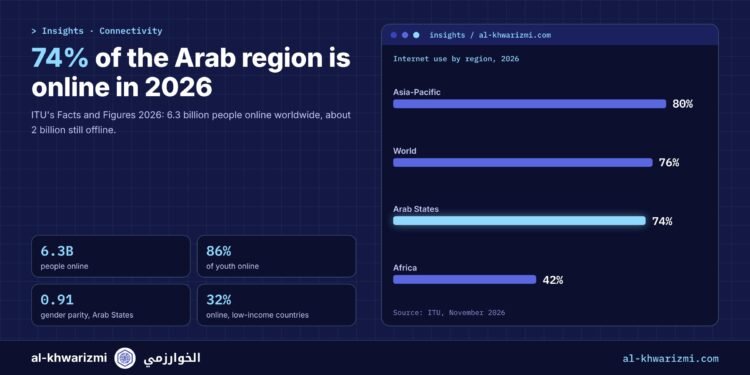
74% of people in the Arab States use the Internet in 2026, close to the global rate of 76%, according to Measuring digital development: Facts and Figures 2026, published by the International Telecommunication Union (ITU) in November 2026. ITU estimates that about 2 billion people worldwide remain offline this year.
About the report
| Publisher | International Telecommunication Union (ITU), Telecommunication Development Sector |
| Released | 3 November 2026 |
| Title | Measuring digital development: Facts and Figures 2026 |
| Data covered | Global, regional and income-group estimates for 2026: Internet use, network coverage, subscriptions, affordability, digital skills, mobile phone ownership |
| Latest edition? | Yes, as of November 2026 |
Facts and Figures is ITU’s annual reference on the state of global connectivity. ITU revises earlier years’ estimates whenever new country data arrives, so figures for 2025 may differ slightly from last year’s edition.
Key findings
- ITU estimates that 6.3 billion people, or 76% of the world’s population, use the Internet in 2026, up from 74% in 2025, while about 2 billion remain offline.
- Internet use in the Arab States reached 74% in 2026, according to ITU, two points below the global average and far above Africa at 42%.
- The gender parity score for Internet use in the Arab States rose to 0.91 in 2026 from 0.84 in 2019, ITU reports. The gap is narrowing, but parity starts at 0.98.
- 86% of young people aged 15 to 24 use the Internet worldwide, compared with 74% of the rest of the population, according to the report.
- Internet use reaches 93% in high-income countries but only 32% in low-income countries in 2026, ITU finds.
- About six in ten people worldwide are covered by 5G, and four in ten mobile-broadband subscriptions are now 5G subscriptions, according to ITU.
| Region (ITU, 2026) | Share of people using the Internet |
|---|---|
| World | 76% |
| Asia-Pacific | 80% |
| Arab States | 74% |
| Africa | 42% |
| Europe, the Americas, CIS | 87% to 93% |
What this means for people building digital skills
Access is no longer the main barrier in the Arab region. With three in four people online, the question shifts from getting connected to using that connection well. ITU itself notes that mobile phone ownership is higher than Internet use in most countries: owning a device does not make someone a capable user. Skills in security, AI tools and content creation decide who actually benefits.
Arabic learning content has a growing audience. If you teach, train or create, your potential audience grows every year, especially among young people, 86% of whom are online globally. Practical guides in Arabic serve readers who are connected but still looking for resources in their own language.
The gender gap is a training opportunity. The rise of the Arab States’ parity score from 0.84 to 0.91 means many women have come online recently. Digital skills programmes aimed at them, from basics to privacy and account security, speak to a new and growing group of learners.
5G makes heavier tools practical. With six in ten people covered by 5G, cloud AI tools, video and automation become realistic for everyday work. Start with the right tools in our practical guides, and see how AI platforms are changing in our look at OpenAI’s DevDay 2026.
📥 Full report: Read Facts and Figures 2026 for free on the ITU website.
FAQ
The International Telecommunication Union (ITU), the UN specialized agency for information and communication technologies, in November 2026.
74% in 2026, according to ITU, compared with 76% worldwide.
Estimates for 2026, with comparisons to earlier years such as 2019 and 2025.
Yes, the 2026 edition is the latest as of November 2026.