
Every website needs a strong foundation of trust. An SSL certificate provides that foundation. It is a digital file that creates a secure, encrypted link between a visitor’s browser and your web server.
This guide explains how these digital certificates work. We detail the role of a certificate authority in their issuance and validation. You will learn the different validation levels and certificate types available for your business.
Understanding SSL protection is crucial. It safeguards login and payment data. It also builds customer confidence and improves search engine rankings. Our goal is to give you the knowledge to make a smart purchase.
Key Takeaways
- SSL certificates encrypt data between a browser and a server to protect sensitive information.
- They are essential for website security, customer trust, and achieving better SEO results.
- Certificates are issued and validated by trusted organizations called Certificate Authorities (CAs).
- Different validation levels (like Domain, Organization, and Extended Validation) offer varying degrees of trust.
- Various certificate types exist, including single-domain, wildcard, and multi-domain options.
- This guide will help you understand the ecosystem, including related tools like code signing certificates.
- You will finish equipped to select the right certificate that balances security, trust, and cost.
Why Your Website Needs an SSL Certificate
The absence of an SSL certificate on your website can immediately erode visitor confidence and harm your online credibility. Today, this digital certificate is a non-negotiable standard for any site.
It activates the HTTPS protocol and the familiar padlock icon in the browser address bar. These are universal signals of security that users actively look for.
Without this protection, browsers like Chrome and Firefox mark pages as “Not Secure.” This warning drastically increases bounce rates and damages your business reputation.
The core function is encryption. An SSL certificate secures all data traveling between a visitor’s browser and your web server.
It prevents hackers from intercepting sensitive details. This includes credit card numbers, personal information, and login credentials.
Search engines also reward secure sites. Google confirms HTTPS is a direct ranking factor. Websites with SSL have a verified SEO advantage.
For e-commerce and any service handling customer data, these certificates are essential. They are required for compliance with standards like PCI DSS.
A key benefit is identity authentication. The certificate proves your website’s legitimate business name. This assures visitors they are not on a phishing site, building critical consumer trust.
Modern web performance often depends on HTTPS. Features like HTTP/2 and Progressive Web Apps require it to function. SSL is necessary for both speed and advanced capabilities.
Even simple blogs or brochure sites gain from this security. It protects user privacy and supports the trend toward a safer web for everyone.
Investing in an SSL certificate demonstrates your commitment to safety. It provides a secure environment for customer interactions and protects your online services.
Understanding SSL Validation Levels: DV, OV, and EV
The validation process behind an SSL certificate is what separates a basic padlock from a verified business identity. Certificate Authorities offer three main validation levels.
These are Domain Validation (DV), Organization Validation (OV), and Extended Validation (EV). Each level requires a different depth of check before a certificate is issued.
Your choice directly impacts the trust signals you send to visitors and should match your website’s purpose.
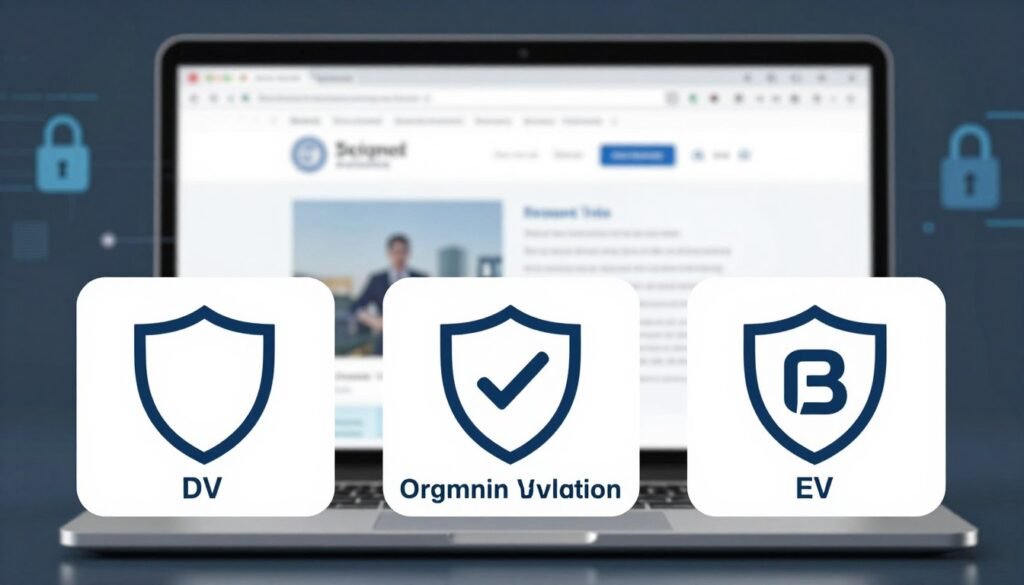
Domain Validation (DV): Fast and Affordable
Domain Validation is the simplest and fastest validation process. It confirms you control the domain name.
Verification often happens via email or a DNS record. This allows certificates to be issued minutes after request.
DV SSL provides essential encryption and security. It is ideal for blogs, personal sites, or internal tools.
The focus is on low cost and rapid deployment. It does not verify your business identity.
Organization Validation (OV): Building Business Trust
Organization Validation adds a crucial layer of authentication. The CA checks your company’s legal and physical existence.
This involves reviewing official documents like business registrations. The process provides a higher level of user confidence.
OV certificates are perfect for corporate websites and customer portals. They show a verified organization stands behind the site.
Issuance takes 1-7 days. These certificates often include a warranty, sometimes valued at validation 50,000 dollars.
Extended Validation (EV): The Highest Standard of Trust
Extended Validation represents the gold standard. It requires the most rigorous manual checks by the CA.
The process validates legal, physical, and operational details thoroughly. This achieves the highest level trust possible.
The major benefit is visible in the browser. An EV SSL certificate displays your legal company name directly in the address bar.
This green bar or name is a powerful trust signal for customers. It is essential for banks, e-commerce giants, and any site handling sensitive data.
Warranties for EV can reach up to $1.75 million. The validation timeframe is similar to OV, taking several business days.
Choosing the right validation level balances speed, cost, and the trust your business needs to project.
Types of SSLs: Matching a Certificate to Your Website’s Needs
Beyond validation levels, SSL certificates are categorized by how many domains and subdomains they can secure. This domain coverage determines the scope of ssl protection a single certificate provides.
Choosing the right type is crucial for operational efficiency and cost management. It depends entirely on your website’s structure.
Single Domain SSL Certificates
A single domain SSL certificate secures one fully qualified domain name. This includes both the www and non-www versions of the same address.
It is the most common and cost-effective choice. You use it for a simple business website with no subdomains.
This certificate provides essential encryption for all data to and from your web server. It is available at all validation levels: DV, OV, and EV.
For a basic online presence, a single certificate is often the perfect fit. It delivers strong security without complexity.
Wildcard SSL Certificates
Wildcard SSL certificates are incredibly efficient for sites with many subdomains. They use an asterisk (*) in the domain name to secure them all.
For example, a wildcard for *.example.com protects blog.example.com, shop.example.com, and mail.example.com. It covers an unlimited number of subdomains under one root domain.
The operational benefit is huge. You manage one certificate instead of many. This is ideal for development environments or SaaS platforms.
These digital certificates offer significant cost savings over time. They are typically available for OV and DV validation levels.
If your site structure is dynamic, a wildcard ssl is a smart investment. It simplifies issuance and renewal for your entire ecosystem.
Multi-Domain (SAN/UCC) SSL Certificates
Multi-Domain SSL certificates secure a list of completely different domain names. They are also called SAN or UCC certificates.
One single certificate can protect example.com, example.net, and yourcompany.org. This is perfect for businesses with multiple brands.
Providers often allow you to secure up to 100 domains initially. You can add, remove, or replace domains during the certificate’s lifetime.
This flexibility is key for complex web infrastructures. It centralizes management of ssl tls protection for all your properties.
Managing multiple domains under one certificate reduces administrative hassle. It also lowers the cost compared to buying many individual certificates.
Assess your current domain and subdomain structure. Anticipate future growth to choose the right type.
The correct wildcard ssl or multi-domain ssl certificate prevents the headache of managing many separate files. It ensures seamless ssl protection as your organization expands.
How to Choose the Right SSL Certificate for Your Business
Navigating the options for SSL certificates requires a clear understanding of your website’s architecture and goals. Selecting the optimal certificate is a strategic decision. It balances technical needs with the trust you must inspire in visitors.
A methodical evaluation of your environment and objectives is essential. This process ensures you get effective SSL protection without overspending.
Assessing Your Domain and Subdomain Structure
Start by mapping your digital property. List every domain and subdomain you need to secure now and in the near future.
This inventory dictates the type of SSL certificate you need. A simple, single-domain site requires a different solution than a complex network.
For one primary domain with no subdomains, a single certificate is perfect. It covers both the www and non-www versions efficiently.
Does your site use subdomains like shop.yoursite.com or app.yoursite.com? A wildcard SSL is the most efficient choice. It secures unlimited subdomains under one root.
Businesses managing several distinct domains should consider a Multi-Domain certificate. This single certificate can protect multiple website addresses.
Choosing the right type from the start prevents management headaches. It also saves money compared to buying many individual certificates.
Evaluating the Required Level of User Trust
The validation level of your certificate directly signals credibility to your customers. Your industry and website purpose determine this need.
A basic blog or informational site often works well with Domain Validation (DV). It provides encryption without verifying your business name.
Websites handling logins, data, or transactions need more assurance. Organization Validation (OV) confirms your organization‘s legal existence.
For e-commerce, finance, or any site requiring maximum customer confidence, Extended Validation (EV) is key. It displays your verified company name in the address bar.
This visible trust marker can reduce cart abandonment and build loyalty. The validation process becomes more rigorous with each level.
Match the validation to the sensitivity of your services. Higher trust often justifies a higher investment.
Considering Warranty and Support
Warranty coverage is a financial safety net from the certificate authority. It offers compensation if a flaw in the certificate leads to a loss.
Typical amounts vary by validation. DV often includes a $10,000 warranty. OV can range from $50,000 to $250,000.
EV certificates offer the highest protection, sometimes up to $1.75 million. This warranty reflects the security assurance provided.
Reliable customer service is equally crucial. Look for providers offering 24/7 support from experts.
This ensures help is available during issuance, installation, or renewal at any time. Good support prevents costly downtime.
Also, check for features like unlimited server licenses. This allows installation on multiple servers without extra fees.
A policy for free reissuances is valuable for managing changes. Some digital certificates include a trust seal to display on your site.
Prioritize certificate providers with a strong reputation for reliability and clear documentation. Quality customer service protects your investment.
SSL Certificate Costs: What to Expect
The price tag on an ssl certificate is determined by several key factors. Understanding these helps you budget effectively for your website’s security.
Costs are not one-size-fits-all. The validation level and domain coverage type are the primary drivers of certificate price.
A basic Domain Validation certificate is the most affordable. You can find DV ssl for as low as $5.99 per year from authorized resellers.
Standard pricing from official sources often ranges from $36.75 to $88 annually. This level provides essential encryption for a single domain.
Organization Validation certificates cost more. Prices typically range from $48.40 to $184 per year.
The higher certificate price reflects the manual checks on your business. It also includes a more substantial warranty for your customers.
Extended Validation represents the top tier. EV ssl certificate costs start around $74.25 and can reach $257.67 annually.
This investment buys the most rigorous validation process. It delivers the highest visible trust indicators for your organization.
Covering multiple subdomains increases cost. A wildcard certificate secures unlimited subdomains under one root.
Expect to pay between $224.25 and $460 per year for this type. It simplifies management for complex sites.
For securing completely different domains, a Multi-Domain certificate is the solution. These often start around $141.60 per year.
The brand of the certificate authority also affects price. Well-known CAs command a premium for their established trust.
You can often get the same genuine digital certificates at a discount. Authorized resellers purchase in bulk and pass savings to you.
Always consider the total cost of ownership. Look beyond the first-year issuance fee.
Check renewal prices and policies for adding domains. Reliable customer service and support services add value.
Evaluate the certificate cost in the context of the security and trust it delivers. The right choice protects your web server and your business name.
Purchasing and Installing Your SSL Certificate
Implementing ssl protection on your website requires completing two main phases: purchase and installation. This process ensures your site gains the encryption and trust signals you selected.
The first step is generating a Certificate Signing Request (CSR) on your web server. This file contains your public key and identifying details about your organization and domain.
You submit the CSR to your chosen certificate authority or reseller. Then, you complete the order for your selected certificate product.

This action triggers the specific validation process for your chosen level. The issuance timeline depends entirely on this validation.
For a Domain Validation (DV) certificate, the check is automated. Certificates issued minutes after request are common using protocols like ACME.
You often verify domain control via email or a DNS record. This makes DV the fastest type to obtain.
Organization and Extended Validation require manual checks. The CA reviews official business documents for authentication.
This process for OV and EV certificates typically takes 1 to 7 business days. The certificate authority confirms your legal business name and physical address.
Upon successful validation, the CA issues your digital certificate files. You receive these via email or download from your account portal.
The next phase is installing these files on your origin web server. The method varies by your hosting environment.
Common platforms include cPanel, Plesk, Apache, Nginx, and Microsoft IIS. Each has specific steps for certificate installation.
Proper configuration is critical for full security. You must set up permanent redirects from HTTP to HTTPS on your site.
Also, resolve any mixed content issues where HTTP resources load on HTTPS pages. This ensures the padlock icon appears correctly.
Many hosting providers and CAs offer professional installation services. This paid option is a valuable time-saver if you lack technical expertise.
After installation, verify everything works correctly. Use free online SSL checker tools for this task.
These tools confirm the certificate is properly installed, valid, and trusted by all major browsers. They also check for chain issues.
Ongoing management is part of owning an ssl certificate. Set calendar reminders for your renewal date well in advance.
Many providers offer auto-renewal options for convenience. Understand how this works with your payment method.
Know how to reissue a certificate if your private key is compromised. Most CAs allow free reissuances during the certificate term.
A major trend is automation using the ACME protocol. It streamlines the issuance and renewal of DV and even OV certificates.
Services like Let’s Encrypt popularized this. Now, many commercial CAs also offer ACME-based automation for easier ssl management.
Following these steps ensures a smooth purchase and setup. Your website will deliver secure, encrypted connections to every customer.
Conclusion: Securing Your Site with Confidence
Securing your website with an SSL certificate is a decisive move for any business operating online. This guide has equipped you to understand validation levels and digital certificates.
Your choice hinges on a clear assessment of your domain structure and required trust level. This investment provides essential SSL protection and safeguards customer data.
It also boosts search rankings and solidifies your organization‘s reputation. Compare offerings from reputable certificate authorityies to find the best value.
With a properly installed certificate, you operate on a secure server with confidence. The journey to enhanced website security begins by taking action today.